
What is ClearWork?
Limited Time Offer
Core Features
- Process discovery & mapping
- Future state transformation planning
- AI assistant to your users offering in app guidance and automation workflows
Pricing Details
Ideal For
Use ClearWork as an Alternative to
Detailed Description
TL;DR
ClearWork is the process mapping software that actually watches work happen, turns it into a designed future state with measurable ROI, and then drives adoption and AI-powered execution inside your tools—so you can transform how the business runs, not just document it.
Discover the Current State (Automatic process mapping & task mining)
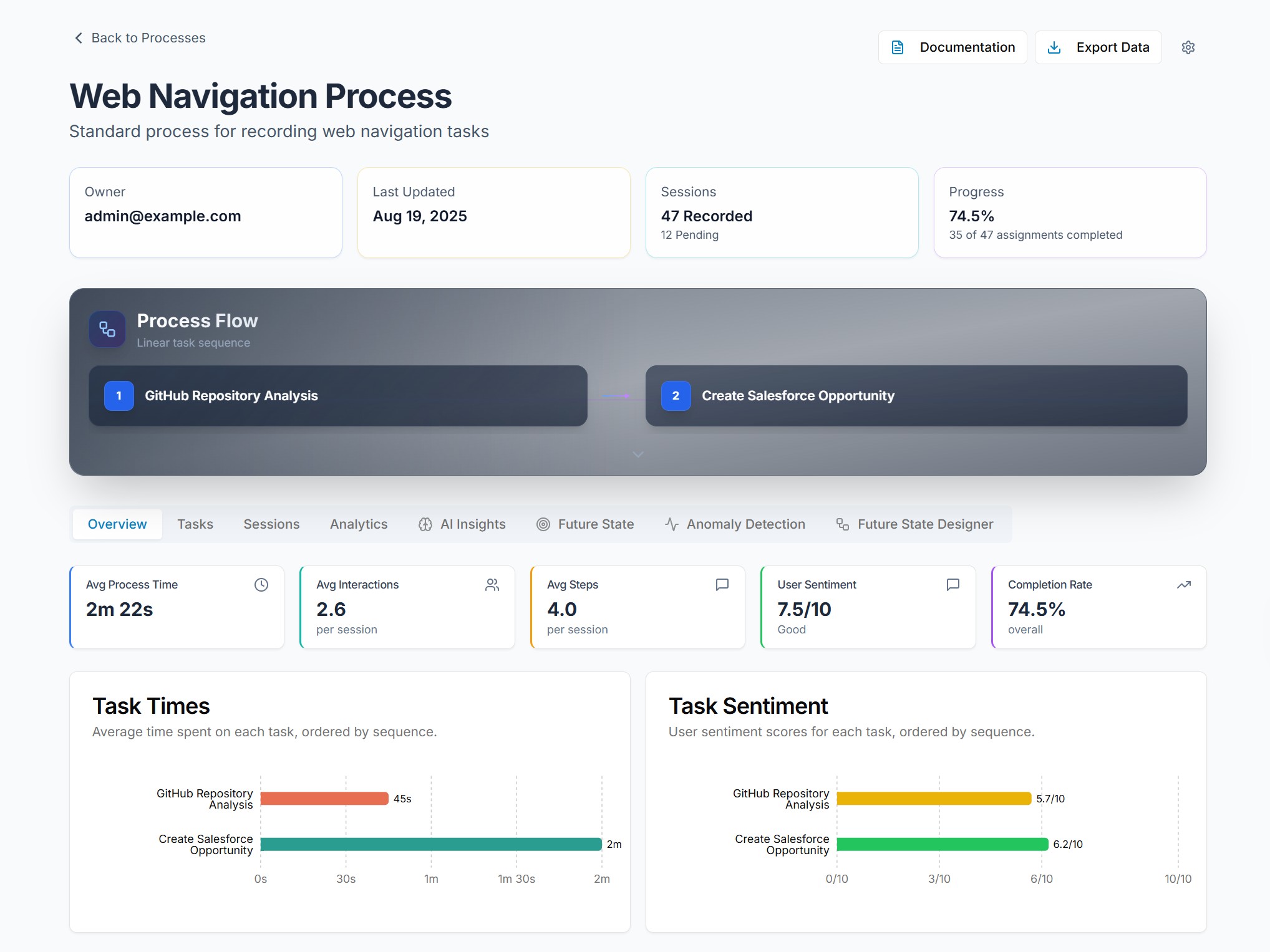
What it does: ClearWork captures how work actually happens—clicks, fields, pages, timestamps, switches between apps—directly from the browser and key enterprise systems. It unifies these events into a single, time-ordered work timeline to reveal true processes at the task level.
How it works
-
Lightweight capture: A privacy-aware browser extension and system connectors record page titles/URLs, user actions, dwell time, copy/paste, and form interactions—without screen recordings by default.
-
Automated process discovery: ClearWork’s models detect recurring sequences and variants, stitching tasks into flows (e.g., “triage → research → update → approval → close”).
-
Entity & context inference: We automatically label steps with tickets, cases, opportunities, accounts, or vendors, so flows align to business objects you already use.
-
Unified timeline: Cross-app activity (e.g., Salesforce + Zendesk + Gmail + Sheets) is merged into a single trace, exposing the real handoffs, waits, and rework.
-
Friction analytics: Time-on-task, idle time, backtracking, form-field error loops, multi-tab toggling, and copy-paste “shadow processes” are highlighted.
-
Security & governance: Role-based access, workspace scoping, PII redaction, opt-in sessions, and audit logs keep data safe and reviewable.
What you see
-
Automatic process maps with variants and frequency (no workshops required).
-
Heatmaps of time sinks, bottlenecks, and error-prone fields.
-
Persona & segment views (new reps vs. experts, region A vs. B) to see where work actually diverges.
-
Baseline metrics (cycle time, touches, hops, SLA adherence) that become your measurable starting point.
Why it matters: Most “process mapping software” documents how work should happen. ClearWork shows how it does happen—fueling accurate, data-driven transformation.
Plan the Future State (Design studio, governance & automation recommendations)
What it does: Turn your discovered “as-is” flows into a designed, governed, and executable “to-be”—with templates, SOP drafts, and AI-assisted improvements you can publish to the business.
How it works
-
BPMN-style editor: Drag-and-drop to modify steps, decision points, and roles. Start from the discovered map to avoid blank-page design.
-
Optimization engine: AI suggests consolidations, parallelization, and elimination of non-value-add steps; flags data re-entry and hand-offs that create delays.
-
Automation finder: Identifies repetitive sub-tasks suited for RPA, native app automation, or agentic orchestration (e.g., “auto-populate fields from source,” “bulk update cases,” “schedule follow-ups”).
-
SOP auto-drafts: Generate role-specific SOPs and checklists straight from the future-state design, including inputs/outputs, system screens, and acceptance criteria.
-
Requirements & governance module: Convert design changes into structured requirements, RACI, and sign-off workflows; track open questions, decisions, and dependencies.
-
Value modeling: Compare current vs. future state with scenario analysis (hours saved, cycle time reduction, cost-to-serve, SLA lift) and export a one-pager business case.
What you see
-
Before/after dashboards with projected impact and implementation effort.
-
Role-aware swimlanes that clarify responsibilities and approvals.
-
Implementation plan (phased rollouts, dependencies, go-live checklist).
Why it matters: Traditional “business process mapping tools” stop at diagrams. ClearWork carries you through requirements, approvals, and an executable plan—so your design doesn’t die in a deck.
Drive Adoption & AI Workflows (In-flow guidance and agentic orchestration)
What it does: Ship the future state into people’s day-to-day tools. ClearWork delivers in-flow guidance and agentic workflows that execute steps, fetch context, and coordinate across apps—so adoption isn’t an afterthought, it’s built in.
How it works
-
In-flow guidance: Contextual guidance appears at the right step, in the right app (e.g., Salesforce, Zendesk, Workday, web tools). Prompts adapt by persona and proficiency.
-
ADKAR-aligned nudges: Awareness → Desire → Knowledge → Ability → Reinforcement built into micro-interventions (starter tips for rookies, shortcuts for experts).
-
Governed guardrails: Required fields, validation, and policy checks embedded in the flow—reducing compliance drift.
-
Agentic orchestration: ClearWork’s agent executes multi-step tasks across systems: gather data, pre-fill forms, push updates, schedule follow-ups, trigger downstream bots.
-
Grounded on real work data: The agent is trained and constrained by your discovered current-state traces and approved future-state designs, so it acts in line with policy and reality.
-
Closed-loop learning: Every guided step and agent action writes back to analytics—so you see adoption, outcomes, and where the flow needs another tweak.
What you see
-
Playbooks inside the workflow: Step-by-step guidance with auto-checks, templates, and suggested actions.
-
One-click automations: Buttons that execute the routine parts (compile notes, update status, create follow-ups).
-
Adoption & impact dashboards: Completion rates, cycle-time lift, error reduction, SLA improvement—by team, role, and region.
Why it matters: Most BPM software ends at “go-live.” ClearWork operationalizes the design with AI that’s trusted (because it’s grounded in how your work actually runs) and automation that sticks (because it lives where people work).
End-to-End Benefits at a Glance
-
Time-to-value: Automatic process discovery and automated process mapping cut months of interviews into days.
-
Accuracy: Plans are based on process intelligence from behavioral data, not assumptions.
-
Adoption: In-flow guidance ensures teams follow the new process from day one.
-
Scalable automation: Agentic workflows orchestrate across apps, eliminating swivel-chair tasks.
-
Governance: Requirements, RACI, and approvals are captured and auditable.
-
Continuous improvement: Live metrics and feedback loops keep the process evolving.
Where ClearWork Fits in Your Stack
-
Inputs: Browser activity, enterprise apps (e.g., Salesforce, Zendesk, SAP/Workday), tickets, emails, docs, and logs.
-
Outputs: Process maps, SOPs, requirements, business cases, in-flow guidance, agentic automations, and KPI dashboards.
-
Security: Role-based access, PII redaction, workspace scoping, audit trails, SSO/SCIM, and data residency options.

AMA with Maker (1)
So ClearWork maps actual workflows... can you give me a real example of a hidden bottleneck you helped another company discover? I'm trying to picture how this would work for our messy, real-world operations.