What is FaceGrader?
Core Features
- On-Device Photo Privacy
- Frozen Geometry Engine
- Four Dimension Scoring
Pricing Details
Ideal For
Detailed Description
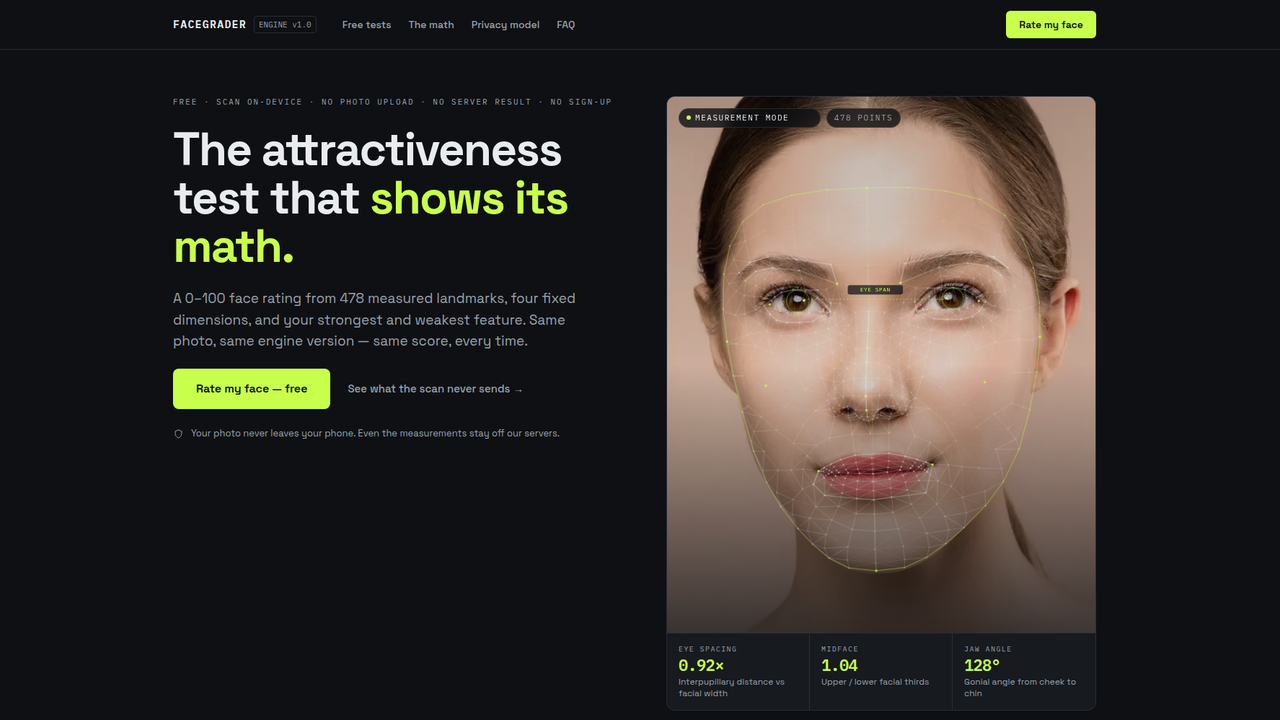
FaceGrader is a facial attractiveness test that shows its math. Built around a single clear, front-facing photo in even light, it measures facial symmetry, proportions, eye tilt and jaw contour, then returns a 0–100 rating showing how four dimensions compare with a fixed geometric reference. Same photo, same engine — same result.
Explore Six Perspectives
✨ Symmetry — two sides, story: see how 30 mirrored landmark pairs line up across the face’s measured center, scored at 35% weight
🎯 Facial thirds — your measured thirds compared with canonical reference coordinates
✨ Facial fifths — your measured fifths compared against the same fixed reference
🎯 Reference ratios — three measured ratios against a reference face
✨ Eye tilt — canthal tilt measured from your photo
🎯 Jawline — jaw contour captured as part of the scan
✨ face, six perspectives, with a result card that carries your score, four dimensions and a short measurement summary
The Engine Behind the Number
FaceGrader runs on Engine v1.0, frozen: four ratios, four fixed weights, number. It returns the same score for the same photo, every time — no model drift, no re-rolls, no scanning again until you like the number. That is something a language model rating your face cannot promise, and it is the whole reason this runs on geometry instead. The score compares four geometric dimensions with fixed reference model. A face that measures far from it is not worse-looking; it is further from that ruler. A high score means closer to that model, nothing more.
What You Get
✨ Your number, four sub-scores, and the highest and lowest dimensions, with the measured points shown
🎯 A saveable PNG card or share link carrying your score, four dimensions and a short measurement summary — the card contains no photo
✨ A free scan that runs in about 20 seconds, no account needed
🎯 An illustrative sample card shows values such as 87.7/100, with the highest dimension at facial thirds and the lowest at reference ratios
Run the check in 20 seconds and see what the scan measures.

AMA with Maker (0)